

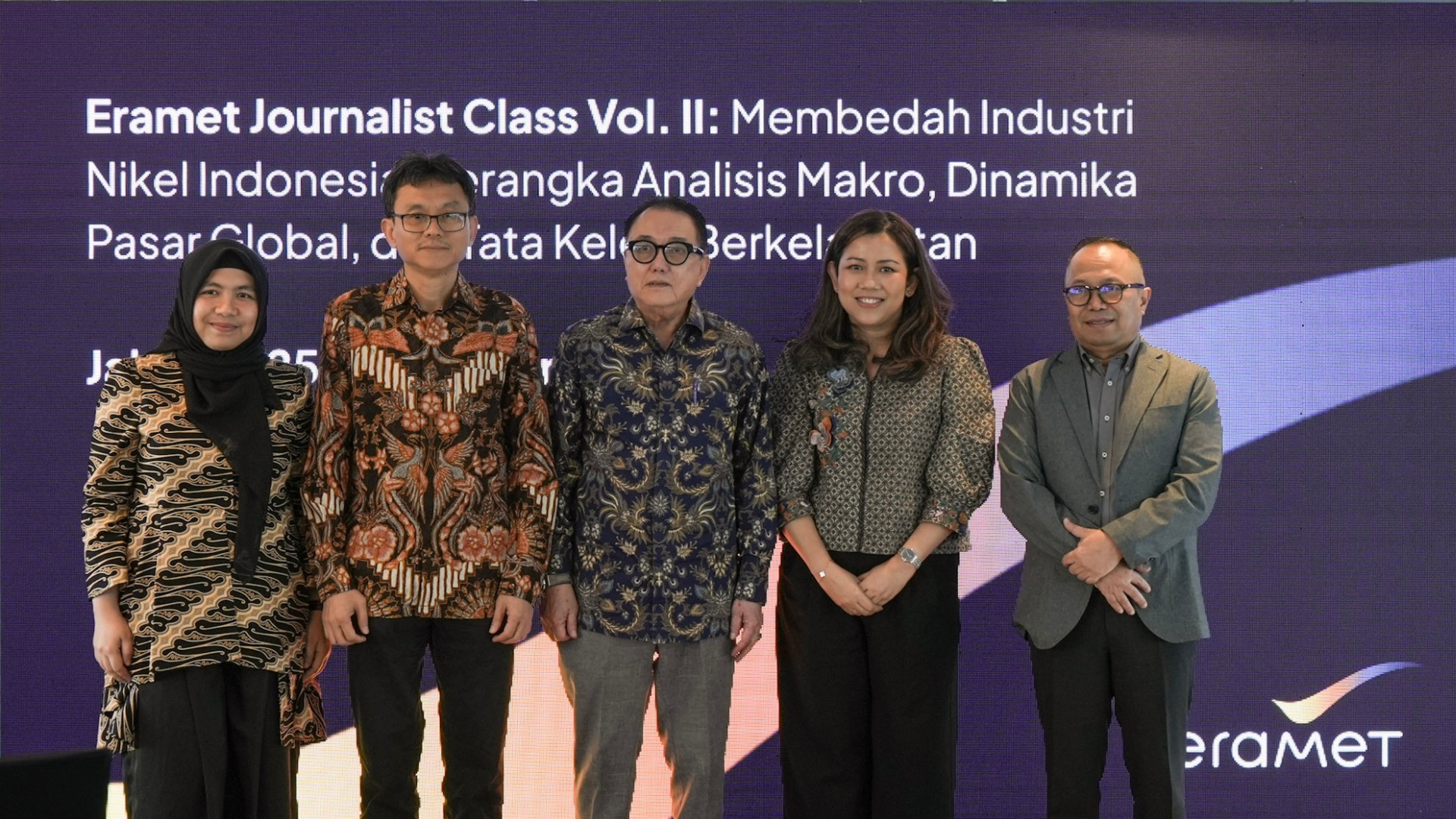
Jakarta, 25 November 2026 – Amid the growing complexity of the nickel industry and its increasingly strategic role in the global critical minerals supply chain, a deeper understanding of the sector’s dynamics is becoming more important than ever, particularly for the media. To support this need, Eramet Indonesia hosted the Eramet Journalist Class Vol. II on Wednesday (25 November), marking the second edition of the program organized during the 2025–2026 period.
Eramet Journalist Class Vol. II tahun ini mengusung tema “Membedah Industri Nikel Indonesia: Kerangka Analisis Makro, Dinamika Pasar Global, dan Tata Kelola Berkelanjutan”. Kegiatan ini bertujuan memberikan pemahaman yang lebih mendalam kepada jurnalis mengenai berbagai faktor yang membentuk industri nikel, mulai dari kebijakan domestik, dinamika pasokan dan permintaan global, kebutuhan industri baterai kendaraan listrik (electric vehicle/EV) dan baja tahan karat (stainless steel), hingga penerapan standar lingkungan, sosial, dan tata kelola (Environmental, Social, and Governance/ESG). Kegiatan ini menghadirkan Agus Superiadi, Konsultan/Senior Advisor Pertambangan Nikel; Arif Perdana Kusumah, Ketua Umum Forum Industri Nikel Indonesia (FINI); Irwandy Arif, Chairman Indonesia Mining Institute (IMI); serta Dewi Permatasari, Independent Sustainability & ESG Advisor.
Jérôme Baudelet, CEO of Eramet Indonesia, said that the initiative is expected to contribute positively to the long-term sustainability of Indonesia’s nickel industry.
“As a global company that has been present in Indonesia since 2006, Eramet Indonesia considers public understanding an important element in supporting the development of a responsible mining and metallurgy industry. Through the Journalist Class, we hope to share knowledge and support journalists in producing high-quality, fact-based reporting,” said Jérôme Baudelet, CEO of Eramet Indonesia, in Jakarta on 25 November 2026.
During the discussion session, Agus Superiadi highlighted Indonesia’s dominant position in the global nickel industry, both in terms of reserves and production capacity.
“Going forward, global nickel market dynamics will also be significantly influenced by Indonesia’s supply policies. This makes production capacity management increasingly important to maintain market balance and avoid oversupply. The key challenge lies in managing these resources sustainably, taking into account ore availability, the needs of the downstream processing industry, and evolving global demand. Striking the right balance among these factors will be critical to ensuring the long-term sustainability of Indonesia’s nickel industry,” Agus said.
Sementara itu, bergeser ke sisi operasional industri hilir, Arif Perdana Kusumah menggarisbawahi berbagai tekanan ekonomi yang tengah dihadapi fasilitas pengolahan di dalam negeri. “Industri pengolahan saat ini menghadapi tantangan dari sisi operasional maupun biaya produksi. Diperlukan kebijakan yang memberikan kepastian bagi pelaku industri, termasuk dalam penetapan Harga Patokan Mineral (HPM), pengaturan RKAB, dan insentif fiskal. Keseimbangan kepentingan antara sektor hulu dan hilir menjadi penting agar kegiatan pengolahan tetap kompetitif dan investasi hilirisasi dapat berkelanjutan,” ujar Arif.
Turning to the downstream segment of the industry, Arif Perdana Kusumah highlighted the various economic pressures currently facing domestic processing facilities.
“The processing industry is currently facing challenges related to both operational performance and production costs. Policies that provide greater certainty for industry players are needed, including those concerning the Mineral Benchmark Price (HPM), the management of Work Plan and Budget (RKAB) approvals, and fiscal incentives. Striking a balance between the interests of the upstream and downstream sectors is essential to maintaining the competitiveness of processing operations and ensuring the long-term sustainability of downstream investments,” said Arif.
Complementing the discussion from the perspective of global ESG standards, Dewi Permatasari explained the role of international initiatives, including the Initiative for Responsible Mining Assurance (IRMA), in strengthening transparency and accountability across mining operations.
“Global standards help translate ESG commitments into measurable and verifiable practices through independent audits and transparent disclosure of assessment results. This enables stakeholders to better understand a company’s achievements, identify areas for improvement, and monitor the follow-up actions taken. The same principle applies to sustainability programs, including land rehabilitation initiatives based on nature-based solutions, whose success should not be measured solely by the number of trees planted, but also by indicators such as survival rates, ecosystem recovery, and the outcomes they deliver. Therefore, any sustainability claim should be supported by evidence that is measurable, traceable, and reflective of tangible results,” Dewi explained.
Beyond promoting industry literacy through media engagement, Eramet’s commitment to sustainability in Indonesia is also reflected in its tangible community empowerment initiatives. Throughout 2026, Eramet implemented LAKSMI, a capacity-building program for women-led micro, small, and medium enterprises (MSMEs) in partnership with YCAB Foundation in Jakarta and Ternate. The company also continued Eramet Beyond, a scholarship program carried out in collaboration with Kitong Bisa Foundation, which supports 41 students from Eastern Indonesia.
“Through these initiatives, Eramet remains committed to contributing to Indonesia’s journey toward building a competitive mineral industry that creates value for society while upholding the principles of sustainability,” Jérôme said.